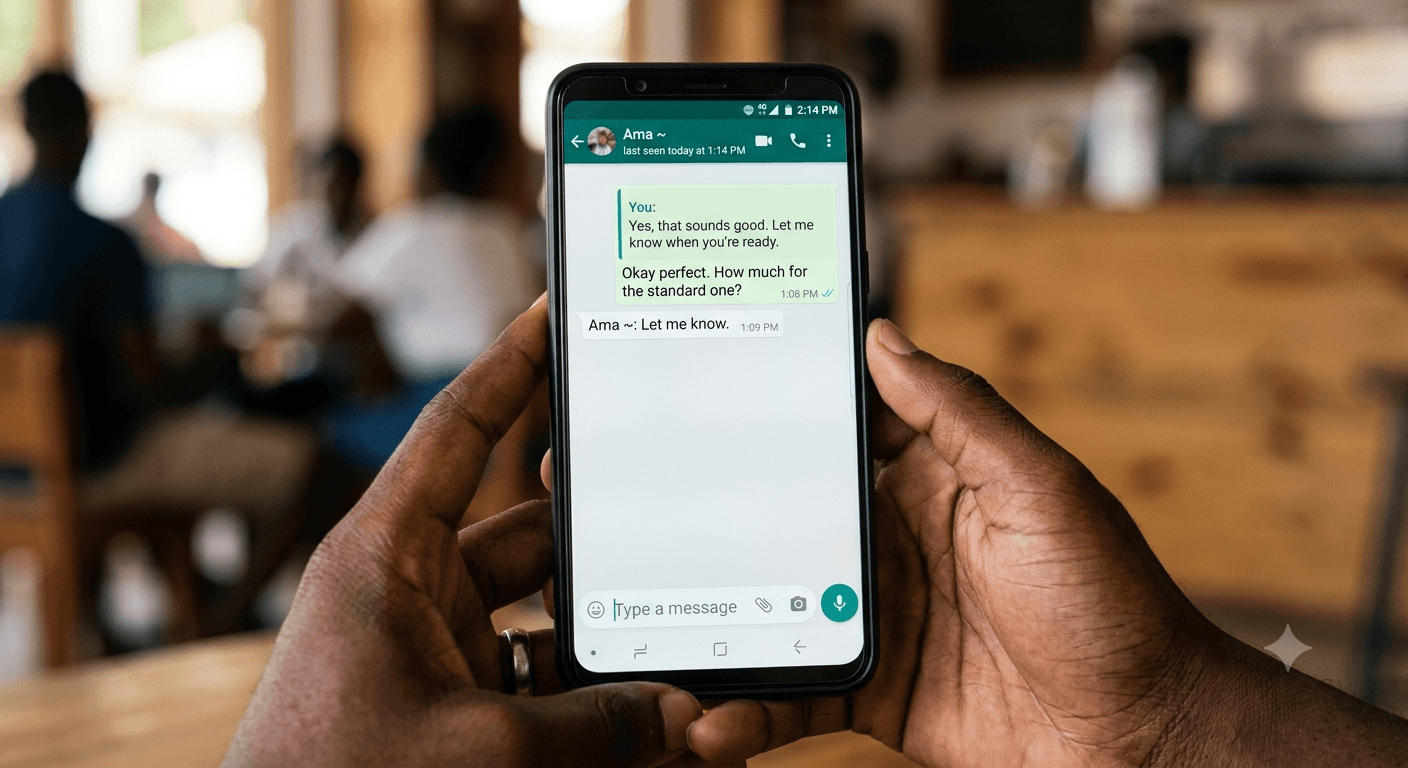
A WhatsApp catalogue shows customers what you have — then leaves them asking 'how do I pay?'. Every one of those questions is a sale stalling. Give them a storefront that takes the money on the spot.
Close the sale where it starts
A WhatsApp catalogue is good at one thing: showing people what you have. Then it hits a wall. The customer is interested, they're ready — and the only thing left is the most fragile part of the whole exchange: 'how do I pay?'. Every one of those questions is a sale balanced on a knife's edge, waiting on a manual back-and-forth that just as often ends in 'I'll come back later'.
A catalogue starts a conversation. A storefront finishes the sale.
GeniYanga gives you a real storefront at your own link — your products, prices, and photos, with live stock — and, crucially, a checkout. The customer picks what they want and pays on the spot with mobile money, card, or OneKhusa. No screenshots of bank details, no chasing, no waiting. The order lands already paid while you're serving someone else, or asleep.
Because it's the same system as your counter, it's one inventory: sell the last unit online and the shelf count drops too, so you never double-sell. And every online order generates the same MRA-compliant receipt as an in-store sale. Selling on the internet doesn't mean selling off the books — it just means the sale finally finishes itself.
Turn 'how do I pay?' into 'paid'.
Stand up your storefront in an afternoon and share one link. The next customer pays before they change their mind.
Questions about selling online.
Straight answers on storefronts, payments, and stock sync.
I already sell on WhatsApp — why do I need a storefront?
WhatsApp is great for showing and chatting — but it can't take the money. A storefront closes the sale at the moment of interest, instead of turning every order into a manual conversation.
Which payment methods can customers use online?
Mobile money, card, and OneKhusa, depending on what you enable. The customer pays at checkout and the order lands paid — no chasing, no 'I'll send it later'.
Will my online and in-store stock stay in sync?
Yes. It's one inventory. A sale on either side updates the count, so you never sell the last item twice.
Do I need a website or a developer?
Neither. Your storefront is generated from the products you already have. Add items, set prices, share the link — you're selling online the same day.